
Requirements
- A current Node.js and npm installation
- A Chromium-based browser
- A supported coding agent such as Codex or Claude Code
- A local, preview, or dedicated staging environment
- Test credentials that contain no real customer or payment data
Safety boundaries
Run tests against disposable data. Block or mock payment, email, deletion, and external messaging actions. Do not provide a personal browser profile when a clean test profile works. Read the generated plan before allowing actions that can change external state.
Initialize Expect
Run the official initializer from the project directory:
npx -y expect-cli@latest initReview which files and agent skills the initializer wants to add. To install only the skill through the documented skills installer workflow:
npx -y skills add https://github.com/millionco/expect --skill expect -yRestart the coding agent after installation so the new skill or command can be discovered.
Run a first test
Start the application, then give the agent a bounded request:
/expect
Complete the sign-up form with valid input.
Also test an empty submission, an invalid email, and repeated clicks.
Check the browser console and a narrow mobile viewport.
Do not submit a real payment or delete data.
A direct CLI run can specify the target URL and goal:
expect-cli -u http://localhost:5173 -m "Test successful and failed sign-in, including empty fields" -yGood targets for exploratory browser tests
- Form validation and error recovery
- Multi-step onboarding
- Navigation after authentication
- Mobile menus and dialogs
- Loading, empty, and error states
- Duplicate submissions
- Browser console and network failures visible to the user
What Expect does
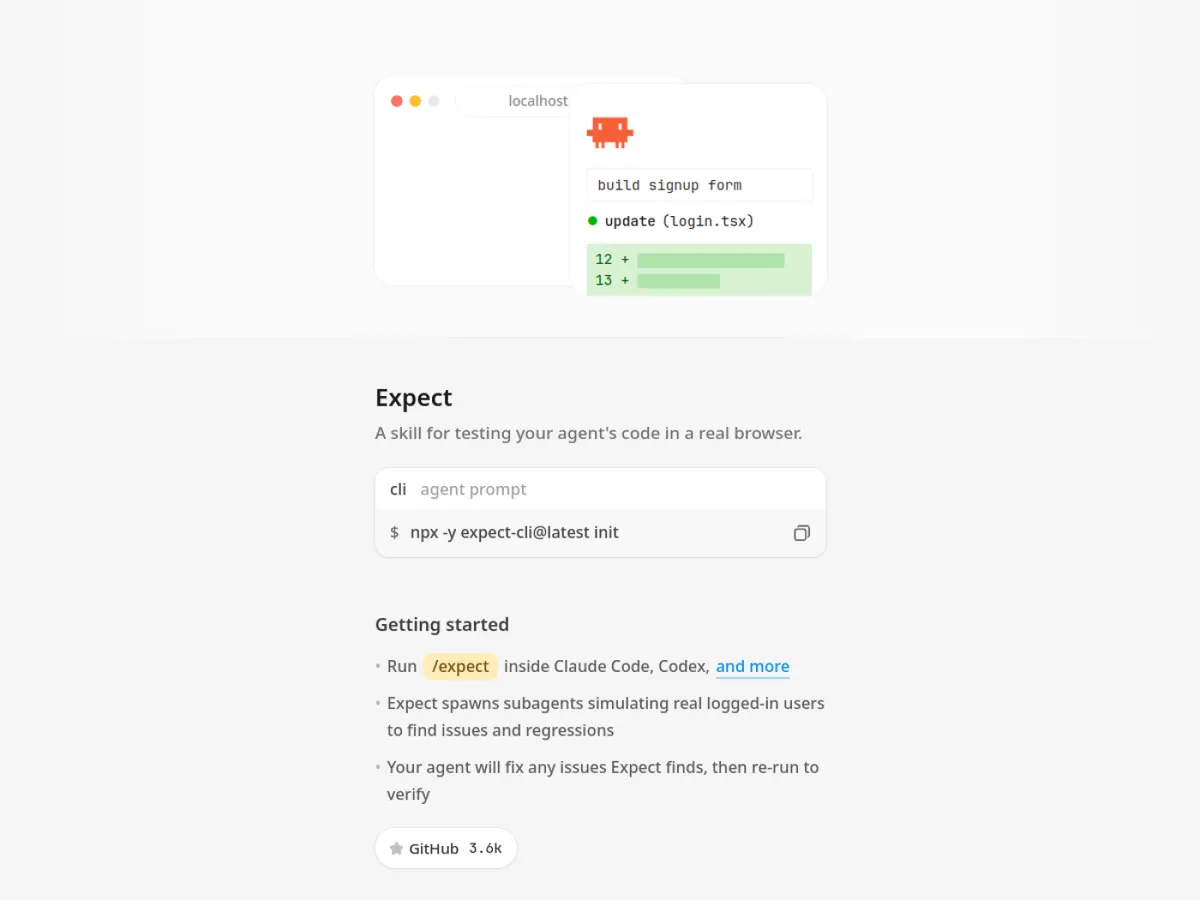
Expect helps an AI coding agent read a change, form a test plan, and exercise the application in a real browser. It is useful for checking not only a happy path but also empty submissions, invalid input, repeated clicks, back navigation, console errors, and responsive behavior.
It complements deterministic end-to-end tests rather than making them unnecessary.
Keep stable regression tests
When Expect finds a real bug, add a deterministic regression test to the repository. Exploratory AI testing is good at discovering unexpected paths; a committed test is better at proving the same failure never returns.