
Set it up before the airport
Create the account and test the verification flow while you still have reliable access to your normal mobile number. Add a payment method, check that the card issuer allows overseas transactions, and save your hotel name in both English and Korean.
At Incheon Airport, Gimpo Airport, or Jeju Airport, use the current airport-pickup reservation option only after confirming the terminal and arrival details. A normal on-demand taxi and a reserved airport pickup are different products and may have different prices or cancellation rules.
The pickup pin matters more than the place name
A hotel, station, or airport can span several roads. Zoom in and place the pin on the side where a car can legally stop. Then compare the app’s pickup description with nearby door numbers, taxi signs, or landmarks.

After dispatch, match the plate number and vehicle description rather than boarding only because a driver says your name. Use the translated chat for short, specific messages such as the terminal door or hotel entrance.
Payment and receipt checks
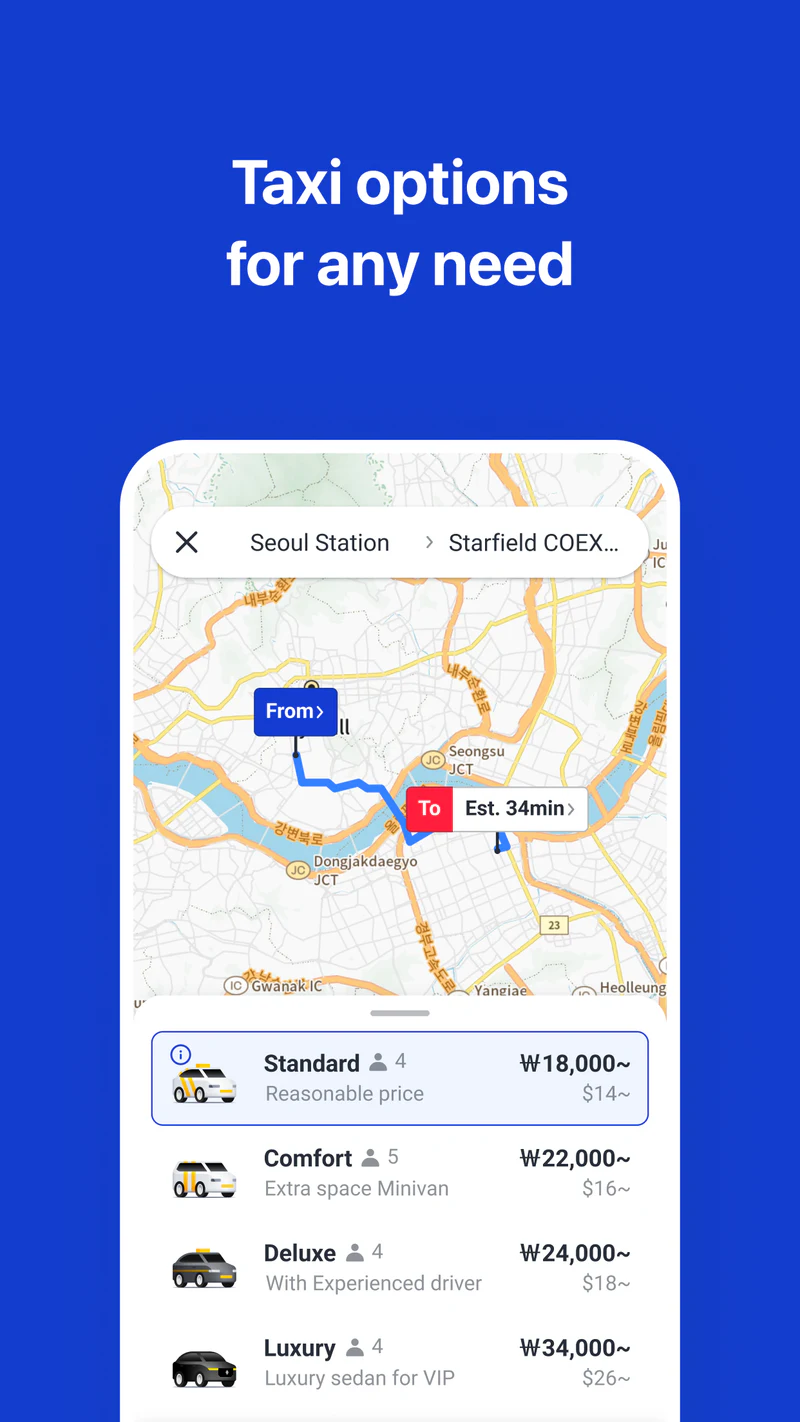
Review the estimated fare before requesting, but treat it as an estimate. After the ride, open the receipt and check the charged amount, tolls, and any additional fee. Use the in-app Support menu if the route or charge appears wrong.
The current store descriptions say support is available year-round from 09:00 to 02:00 the next day, Korea time, while the official website says Monday to Friday and excludes public holidays. Because those official notices conflict, check the Support screen for the service hours shown to your account and do not rely on an immediate response at night or on a holiday.
If the destination search or dispatch fails
Search again with the Korean road address copied from NAVER Map or KakaoMap, not a translated nickname. Confirm the result by district and map position before requesting. If the app repeatedly shows no car, avoid sending several requests at once. Move only to a legal, well-lit pickup road or an official taxi stand, then try once more or use a backup app. At a hotel or station, staff can often identify the correct road faster than a map pin can.
Once a driver accepts, save the plate number and pickup description. If the driver cancels, check that no active ride or cancellation fee remains before opening another app. When mobile data is unstable, screenshot the dispatch screen so you can still identify the arriving car.
Airport pickup and large-luggage reality check
A reserved airport pickup is not the same product as an ordinary on-demand taxi. Reconfirm the airport, terminal, arrival date, flight number, meeting point, included waiting time, and cancellation rule. If a flight is delayed or immigration takes longer than expected, use the reservation’s own contact flow instead of assuming the driver can wait indefinitely.
Vehicle labels are not a luggage guarantee. Count passengers and full-size bags before choosing a class, and read the capacity description shown for that specific booking. If the available car cannot safely take the group, split the party or use an airport bus rather than trying to load luggage into seats or aisles.
Save evidence before reporting a charge
For a wrong route, duplicate charge, cancellation fee, or fare that differs sharply from the estimate, keep the estimated-fare screen, plate number, pickup and drop-off times, receipt, and card transaction. Describe the issue in chronological order through in-app Support. Do not publish full card numbers, passport images, or private contact details in a public review. If a payment is still pending, distinguish a temporary authorization from a completed charge before escalating it with the card issuer.
Why k.ride is different from Kakao T
k.ride is operated by Kakao Mobility but is built for international travelers. In Korea it uses Kakao Mobility’s taxi platform, while the August 2026 store descriptions now present k.ride as a broader service covering 35 countries. This guide evaluates the Korean taxi flow only; vehicle types, payments, and protections can differ abroad.
Its interface is available in English, Japanese, Simplified Chinese, and Traditional Chinese. Destination search and translated driver chat support 133 languages.
The app shows an estimated fare before dispatch and charges the registered payment method after the ride. Official store information lists credit and debit cards, PayPal, Alipay+, and WeChat Pay, although the choices shown can depend on your country and device.